
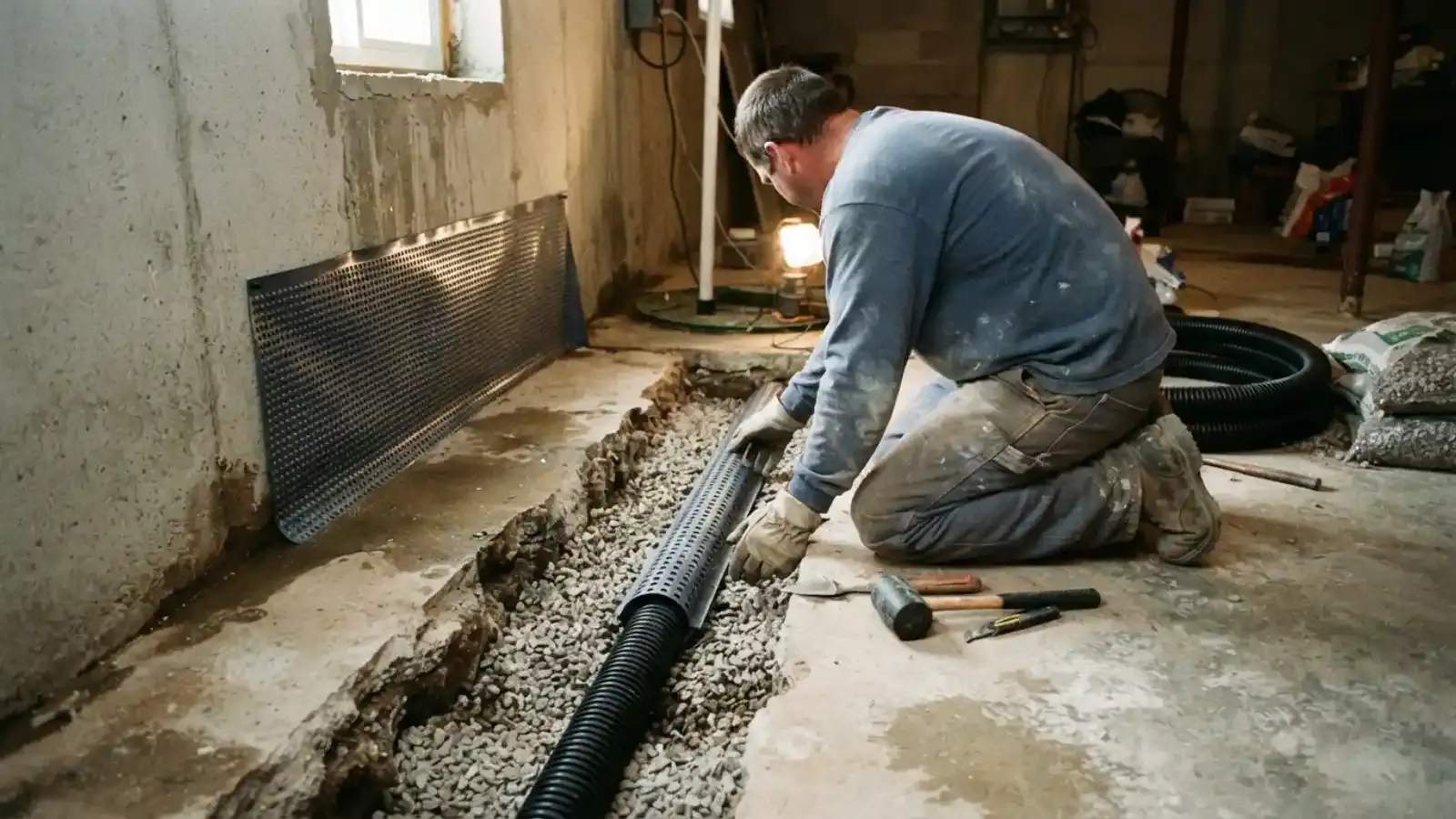
Where basement water comes from
There are four common sources, and each needs a different answer.
| Source | How it shows | Typical fix |
|---|---|---|
| Groundwater through walls or floor | Dampness, seeps at the floor joint | Interior drain and sump |
| Sewer or drain backup | Water at the floor drain | Clean or repair the line |
| Plumbing leak | Wet near pipes, meter moves | Leak detection and repair |
| Surface water at the foundation | Water after rain at one wall | Grading and gutters |
Interior drainage and sump systems
An interior drain channel along the footing collects water that reaches the wall and carries it to a sump pit, where a pump discharges it outside. It is the most common plumbing-side fix for chronic seepage. The pump needs a backup, which our sump pump page describes.
Wall sealing and its limits
Sealers and coatings can help with dampness, but they do not stop water under pressure. We say clearly when a coating is enough and when it is not, and we do not sell a coating for a drain or sewer problem.
Water in the basement?
Call to book a visit. Tell us when it appears and how much.
What to check before calling
A few observations cut the guesswork.
- Does the water appear only after heavy rain, or also on dry days?
- Is it at the floor drain, along the wall or at the joint where the wall meets the floor?
- Do the gutters discharge near the foundation?
- Does the water meter move when everything is off?
- Is there a sewer smell?
Start outside: gutters, grading and window wells
The cheapest fix is often outside. Downspouts that dump beside the foundation, soil that slopes toward the wall, and window wells that fill with rain put water exactly where it can get in. A common rule of thumb is soil falling about six inches over the first ten feet away from the house, and downspouts that discharge several feet out.
We tell you when outside work should come first, since it can stop a problem for far less than an interior system. We do not do landscaping, so we point out what to ask a landscaper or mason to do, and we handle the plumbing side: sump discharge, drain lines and backflow.
What a waterproofing visit looks like
We look at the floor drain, the sump pit if there is one, the walls, the meter and the downspouts, then explain what we think is happening.
Ask
When, where and how much water appears.
Test
Meter check, drain flow, a look at the sump and discharge.
Explain
The likely source in plain terms.
Plan
Fixes in order of cost and likelihood to work.
Basements in Secaucus
Secaucus is an island in the Meadowlands, with the Hackensack River on one side and creeks on the other, so the water table is shallow in places.
During Ida on September 1, 2021, the town pumped out 91 basements, and more than 100 homes had flooding. The town's Ida recovery notice included a Basement Flooding Fact Sheet. In low areas near Centre Avenue and Farm Road, flood-prone sites may be affected by floodplain rules, so ask the construction department before major work. The department is at the Town Hall Annex, 20 Centre Avenue.
Waterproofing cannot stop a river flood. It manages seepage and groundwater. For flood events, protection means a working pump, a backup and careful storage.
What decides the cost of waterproofing
The source decides the plan.
Insurance note: homeowners policies usually respond to sudden, accidental water damage, and usually exclude the repair of the worn part or a slow leak that went on for months. Check your policy or ask your agent before you assume either way. Flood and groundwater are often excluded.
Describe where the water appears for an honest read.
Digging outside the foundation
An exterior drain or a new discharge line means outdoor digging. In New Jersey, whoever is excavating must contact New Jersey One Call at 811 at least three business days ahead. Drain and discharge piping follows the National Standard Plumbing Code, 2021 edition, which New Jersey adopts as its plumbing subcode in N.J.A.C. 5:23-3.15, and Secaucus permit rules vary, so ask the construction department.
Questions about basement waterproofing
Often groundwater pressure or poor drainage at the foundation. A sewer backup is also possible if water appears at the floor drain.
Yes, with an interior drain and sump. It manages water that gets in rather than keeping it out.
It helps when water collects below the floor. It does not fix a sewer backup or surface flooding.
It handles seepage and groundwater. It does not stop a major flood.
Often not for seepage. Policies vary, so ask your agent.
Not sure which fix fits? Call (551) 249-3045 and describe what you see.