
Signs your pipes need replacing
No single sign decides it. A pattern does.
Rust-colored water
Corroding galvanized pipe.
Low pressure at many fixtures
Mineral buildup inside the pipe.
Repeated pinhole leaks
Corrosion has weakened the pipe.
Old pipe material
Galvanized steel and some older plastics have known lifespans.
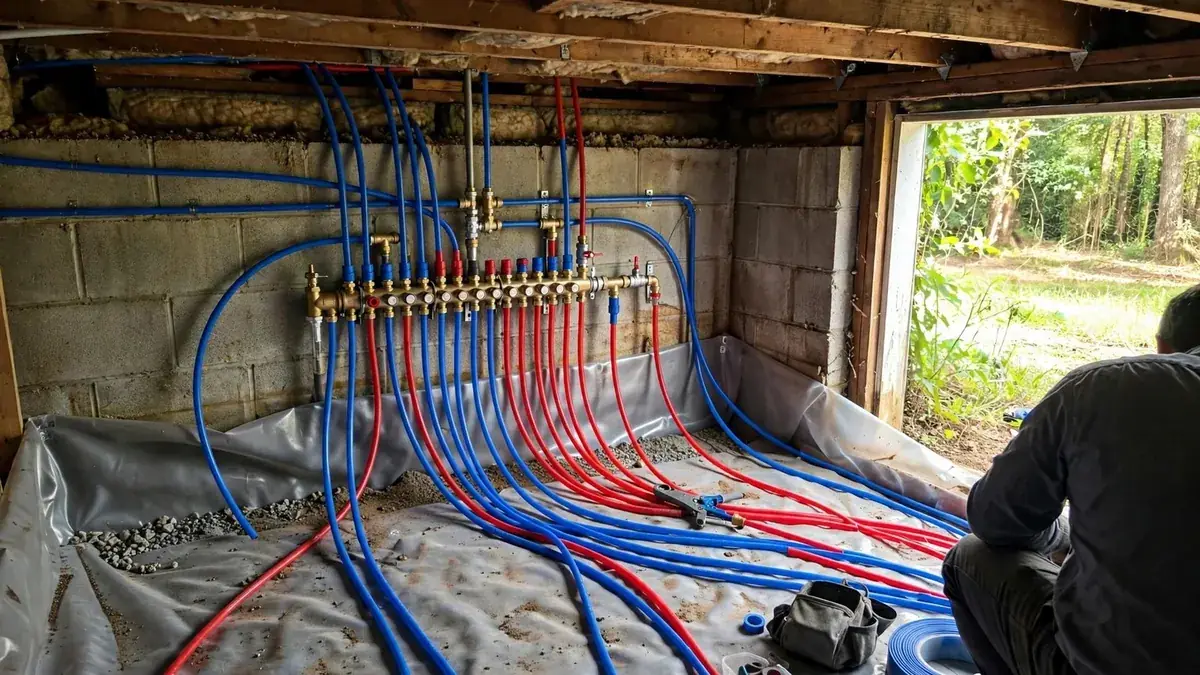
Copper or PEX
Copper is durable and familiar. PEX is flexible, faster to install and handles freezing better, with fewer joints.
| Copper | PEX | |
|---|---|---|
| Install time | Longer | Shorter |
| Walls opened | More | Often fewer |
| Freeze tolerance | Lower | Higher |
| Long-term track record | Longest | Shorter but strong |
| Cost | Usually higher | Usually lower |
The blog guide to copper pipe types explains K, L and M for homeowners who prefer copper.
Thinking about repiping?
Call for a pipe check and a clear price. We tell you honestly if spot repairs are enough.
What the work looks like
Repiping touches every wall that holds a supply line. We plan it in phases so you keep water at night where possible, run new lines to each fixture, test pressure, and patch access holes. If drywall repair or painting is needed, plan for it separately.
When spot repair is enough
One leak in a young pipe is not a repiping case. We tell you when a section repair is the better value. If the pipe is old and a second leak appears within a short time, replacement usually costs less than a string of repairs. For one failure, see burst pipe repair.
Pipe materials: what lasts and what does not
Material tells you how much time a system has left.
| Material | What to know |
|---|---|
| Galvanized steel | Corrodes from the inside. Pressure drops and rust appear first. |
| Copper | Long-lived. Pinholes can appear with certain water or flow conditions. |
| CPVC | Plastic, brittle with age and heat. |
| PEX | Flexible, handles freezing, widely used for repipes. |
| Lead | Never acceptable for drinking water. Replace. |
Questions to answer before you book
Three questions shape the quote, and you can answer them from home.
- How old is the house, and has any of the pipe been replaced?
- Where does the water look rusty, and is it hot, cold or both?
- Is there a basement or crawlspace where the main lines are visible?
- Does your building require approval for work that shuts off a riser?
Whole-house or partial
A whole-house repipe is thorough but disruptive. A partial repipe replaces the worst section, such as the basement trunk line or one bathroom group. We tell you whether the rest of the system is likely to follow soon, so you can decide with the full picture. Pressure reducing valves and water hammer arrestors are worth checking at the same time, since high pressure shortens the life of any pipe.
Repiping in Secaucus homes and condos
Many buildings in Secaucus are townhouses and condos where repiping means working with a management office and a riser. Ask about shutoff schedules and contractor rules before you book.
Permit rules vary, so ask the Secaucus construction department whether repiping at your address needs a permit. The department is at the Town Hall Annex, 20 Centre Avenue. Water chemistry affects pipe life. Ask your water utility for its annual water quality report, or test your tap.
What decides the cost of repiping
It depends on the house.
Insurance note: homeowners policies usually respond to sudden, accidental water damage, and usually exclude the repair of the worn part or a slow leak that went on for months. Check your policy or ask your agent before you assume either way.
Tell us the age and size of the home for a plan.
What the code says about a whole-house repipe
A repipe is a large change to the water system, and in New Jersey it falls under the National Standard Plumbing Code, 2021 edition, which New Jersey adopts as its plumbing subcode in N.J.A.C. 5:23-3.15. Many towns require a permit and an inspection of the new piping before walls are closed. Ask the Secaucus construction department what applies to your building, since condos may also need association approval.
Questions about repiping
Rust-colored water, low pressure, repeated leaks and old pipe material are the main signs.
A typical home takes a few days. It depends on size and access.
For part of each day. We plan phases to limit it.
It is widely used and performs well. Each has trade-offs.
Usually not for worn pipe. Policies vary.
Not sure which fix fits? Call (551) 249-3045 and describe what you see.