
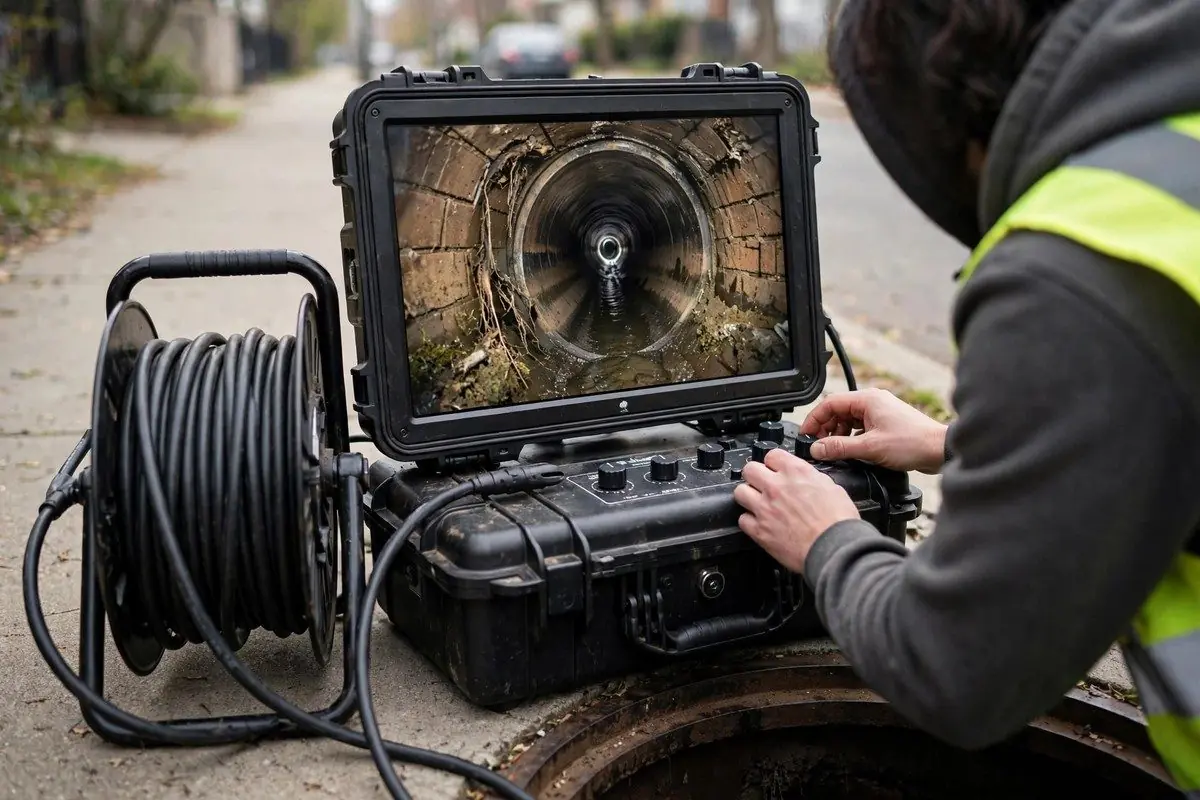
What the camera finds
The camera runs on a flexible cable with a light, and a locator on the surface marks depth and position. Typical findings:
- Roots entering joints in older pipe.
- Cracks and offset joints.
- A belly, or low spot, that holds water and solids.
- Scale or grease narrowing the pipe.
- Collapse, crush or a pipe that stops short of the connection.
- Misconnected or missing cleanouts.
Who should book one
Not every home needs a camera. These situations do:
Buying a home
A line can fail without any sign above ground. Footage before closing gives you a stronger hand in negotiation.
Repeat clogs
A camera finds why a line clogs again after cleaning.
Before digging or lining
A repair quote without footage is a guess.
After a flood or backup
Heavy rain can expose a weakness that stays hidden on dry days.
What happens during an inspection
The visit is short and not disruptive.
Find access
We use a cleanout when there is one, or a fixture or vent when there is not.
Run the camera
The cable goes in and you watch the monitor.
Locate
We mark any problem on the surface with its depth.
Review
We explain what is minor and what is urgent, and give you the video.
What a camera cannot do
A camera sees the inside of a drain line from the access point to where the cable ends. It does not see inside walls, it cannot pass a full blockage until the line is cleared, and it does not test pressurized supply pipes. A clean video is a good sign for the section it covered. It is not a warranty on the rest of the system.
For a condo or townhouse, the line you can reach may be a private branch that joins a shared stack, so the footage may show only your part. We tell you where the camera stopped and why, so you know what the video covers before you rely on it.
Want a look inside your pipe?
Call to book. Same-day appointments are often available.
Reading the result: repair, monitor or ignore
Not every defect needs work. A small root hair in a joint may be handled with a periodic cleaning. A belly that holds a few inches of water may only need monitoring. A crack with soil visible behind it, an offset joint or collapse needs repair. We say which category each finding falls into, and when repair is needed we explain repair and lining options. If the line is only dirty, sewer line cleaning is the next step.
Buying in Secaucus: what to ask
Secaucus has about 9,316 housing units, from older homes near the Plaza to Harmon Cove's townhouses and high-rises developed in the 1970s. Ask whether the unit connects through a shared line, and who maintains it. For a house, a camera on the lateral before closing is cheap compared with a dig.
Sewer discharge rules in town are the Secaucus Municipal Utilities Authority's. Ask the authority where your lateral meets the public main so a finding is assigned to the right owner.
What affects the price of a sewer camera inspection
We give the price before the camera goes in.
Insurance note: homeowners policies usually respond to sudden, accidental water damage, and usually exclude the repair of the worn part or a slow leak that went on for months. Check your policy or ask your agent before you assume either way.
Ask for the video copy when you book.
What the camera report can support
A sewer camera report is a record of the pipe's condition, and it is useful for a repair quote, an insurance question or a home sale. Repairs that follow it fall under the National Standard Plumbing Code, 2021 edition, which New Jersey adopts as its plumbing subcode in N.J.A.C. 5:23-3.15. Keep the video.
Questions about sewer camera inspection
Most visits are under an hour. A blocked line or difficult access takes longer.
We clear it enough for the camera to pass. A heavy blockage may need cleaning first, which is priced separately and explained before we start.
Yes. Ask when you book, especially for a home purchase.
It is a sound step for any older or unfamiliar line. Footage before closing shows hidden defects and helps you negotiate.
It shows cracks and displaced joints in a drain line. For pressurized supply leaks, see leak detection.
Not sure which fix fits? Call (551) 249-3045 and describe what you see.