
What we install
Most installation work falls into a few types.
Fixtures
Sinks, faucets, toilets, tubs, showers, laundry hookups.
New lines
Supply and drain for an added bath, kitchen or laundry.
Appliance connections
Dishwasher, ice maker, washer, water heater.
Basement baths
Rough-in, ejector pumps and venting.
Rough-in, then finish
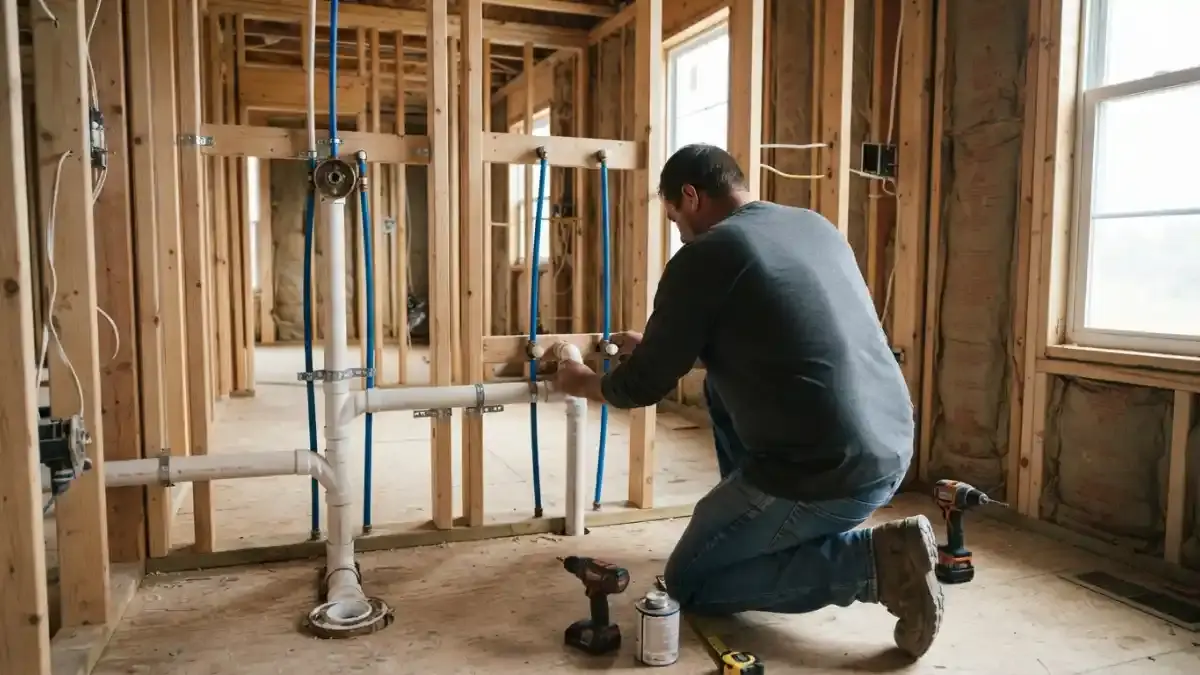
Installation has two stages. Rough-in puts pipes in the walls and floor before they are closed. Finish sets fixtures and trim after walls are done. Inspections, where required, usually come after rough-in, so schedule the walls after the sign-off.
Plan
Fixture locations, pipe sizes, venting and drain slope.
Rough-in
Supply, drain and vent lines installed and pressure tested.
Inspection
If your project requires one.
Finish
Fixtures set, connections tested.
Planning a plumbing project?
Call to discuss scope. We give a price before work starts.
Basement bathrooms and ejector pumps
A basement bathroom below the sewer line needs an ejector pump to lift waste up. It requires venting, a sealed pit and a check valve. If your basement has had water, see basement waterproofing first.
Fixture choice affects plumbing
A freestanding tub, a double vanity, a rain shower head or a tankless water heater each change pipe sizes or locations. Decide fixtures before rough-in, not after. For heaters, see water heater installation.
Laundry hookups and appliances
Washer boxes, laundry sinks, ice makers and dishwashers each need the right supply, drain and shutoff. A washer standpipe that is too short or too low can back up. We install the box, the supply valves and the drain at proper height, and we recommend braided supply lines with accessible shutoffs.
Gas lines: safety first
Gas appliances and gas piping are different from water work. If you smell gas, leave the building and call the gas utility or 911 before calling anyone else. We do not promise any response time for gas leaks. For planned work, such as moving a range or adding a dryer line, we tell you what is needed and what permit rules may apply.
Working in older buildings
Older Secaucus buildings may have cast iron drain stacks and mixed pipe materials. Cutting into them means matching materials and using proper couplings. We check the stack before adding a fixture that will load it, and we say so when a section of old cast iron should be replaced instead of tied into.
Renovations in Secaucus
Permit rules vary, so ask the Secaucus construction department what your project needs. The department is at the Town Hall Annex, 20 Centre Avenue, and its hours are listed on the town website. Plumbing in New Jersey is performed by a master plumber or authorized plumbing contractor, or by employees of one, according to the state's plumbing board. Ask any plumber for their license details and check them with the board.
In condos and townhouses, add your building's rules to the plan. Many require approval, insured contractors and limited work hours.
What decides installation price
Scope drives it.
Insurance note: homeowners policies usually respond to sudden, accidental water damage, and usually exclude the repair of the worn part or a slow leak that went on for months. Check your policy or ask your agent before you assume either way.
Tell us the room and fixtures for a firm scope.
Which rules apply to new plumbing work
New fixtures, new supply lines and new drains follow the National Standard Plumbing Code, 2021 edition, which New Jersey adopts as its plumbing subcode in N.J.A.C. 5:23-3.15. New Jersey requires plumbing to be done by a master plumber, an authorized plumbing contractor or their employees, as the state's Division of Consumer Affairs explains. Ask any contractor to show you what they hold before work starts.
Questions about plumbing installation
Yes, in many cases. We check the model first to be sure it fits the connections.
Permit rules vary, so ask the Secaucus construction department for your project.
Often yes, with an ejector pump. We check slope, venting and the sewer connection.
Ask for the master plumber's license number and confirm it with the State Board of Examiners of Master Plumbers at the Division of Consumer Affairs.
Yes. We can rough in and return for the finish stage.
Not sure which fix fits? Call (551) 249-3045 and describe what you see.