
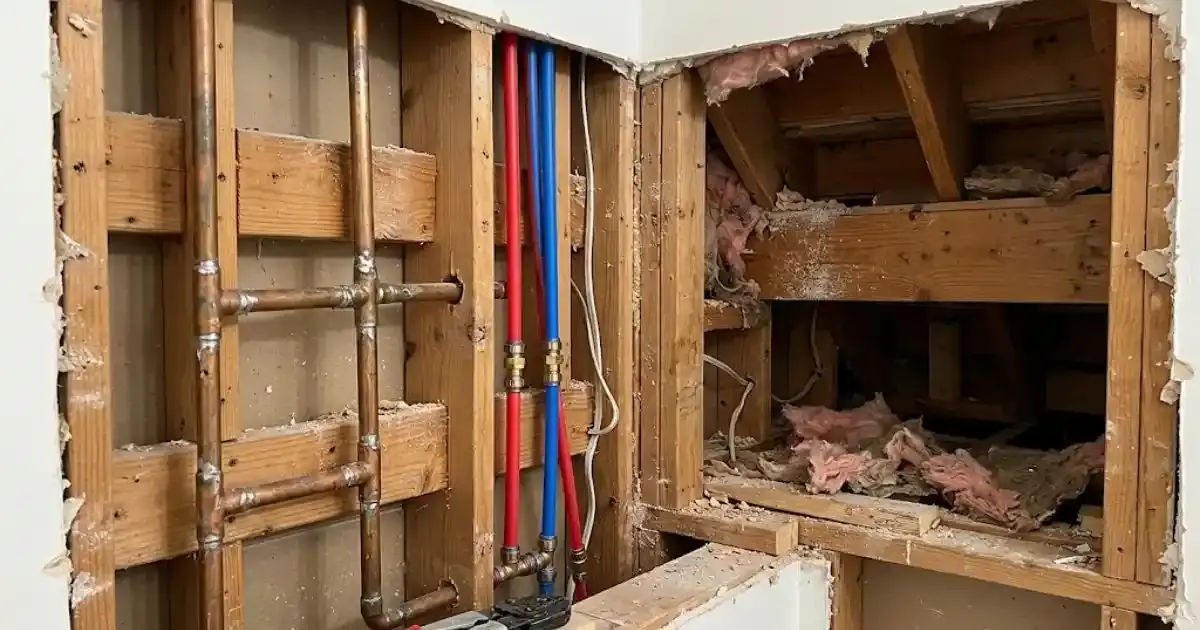
Type K, L and M at a glance
The letters are a thickness grade, not a quality grade. All three are real copper, and all three are made in the same nominal sizes. Thicker walls resist pressure and damage better, and they cost more per foot.
| Type | Wall | Common use |
|---|---|---|
| K | Thickest | Underground water service, heavy-duty runs |
| L | Medium | Interior supply, most residential work |
| M | Thinnest | Interior supply where code and cost allow |
How to tell which type you have
Copper is marked with a color stripe and printed text along the pipe. Type K is marked green, L blue and M red, and the printing gives size and type. Old pipe may have worn marks, so check near a fitting or where the pipe is protected. If you cannot read it, a plumber can measure wall thickness with a gauge.
Which type your project needs
Match the grade to the job. Replacing a section of an existing supply line is usually done in the same type, or in L as a step up. A new underground service line calls for K or another approved material. Ask the Secaucus construction department what applies to your project. It is at the Town Hall Annex, 20 Centre Avenue, and its permit rules vary by job.
Copper versus PEX
PEX is flexible plastic tubing, and it has become the default for many repipes. It takes fewer joints and survives a freeze better. Copper is durable and familiar, and it resists heat and sunlight. If you are choosing, the repiping page compares both. Many homeowners keep copper where it is visible and healthy and use PEX for long hidden runs.
Why copper fails
Copper does not wear out like a tire. It fails when something attacks it. Aggressive water can pit it from inside. High flow can erode elbows. Flux left in a joint, a dissimilar metal connection and vibration can each start a pinhole. A pinhole leak sprays a fine stream and often hides in a wall or ceiling. If you see a stain or hear a hiss, leak detection finds it without opening the whole wall.
Soldering, press fittings and safety
Copper joints are soldered or joined with press fittings. Modern solder is lead-free, and drinking water systems must use it. Press fittings are faster and avoid open flame, which helps in a finished space. Never heat copper near wood without a shield, and never solder a pipe that still holds water.
What it costs, without the guesswork
Copper prices move with the metal market, so a firm number needs a quote. The main drivers are the length of pipe, the type, the number of fittings and how hard it is to reach the run. Opening and closing drywall often costs more than the pipe itself.
Reading a quote for copper work
A fair quote lists the length of pipe, the type, the fittings, the labor and the repair of any wall or ceiling that is opened. If a quote names only a lump sum, ask what is included. Ask also whether the price covers shutting down and restoring water to the unit, since in a building that can take extra visits.
Dielectric unions and mixed metals
When copper meets galvanized steel, the two metals can corrode each other, and the galvanized side suffers. A dielectric union or a brass nipple separates them. It is a small part with a large effect, and it is one of the first things we look for when we find a rotted fitting beside a new copper section.
Freezing, hammer and noise
Copper conducts heat well, so exposed runs in cold spaces freeze faster than insulated ones. Water hammer is a banging when a valve closes quickly, and it stresses joints over time. An arrestor near the fixture and straps at the right spacing quiet the pipes and extend their life.
When to call a plumber
Small, visible repairs are within reach for a careful person with the right tools. Work inside walls, near gas lines, or on a main supply deserves a professional, since a bad joint can leak hidden for months. If you are unsure what material you have, a short visit identifies it and avoids buying the wrong fittings.