
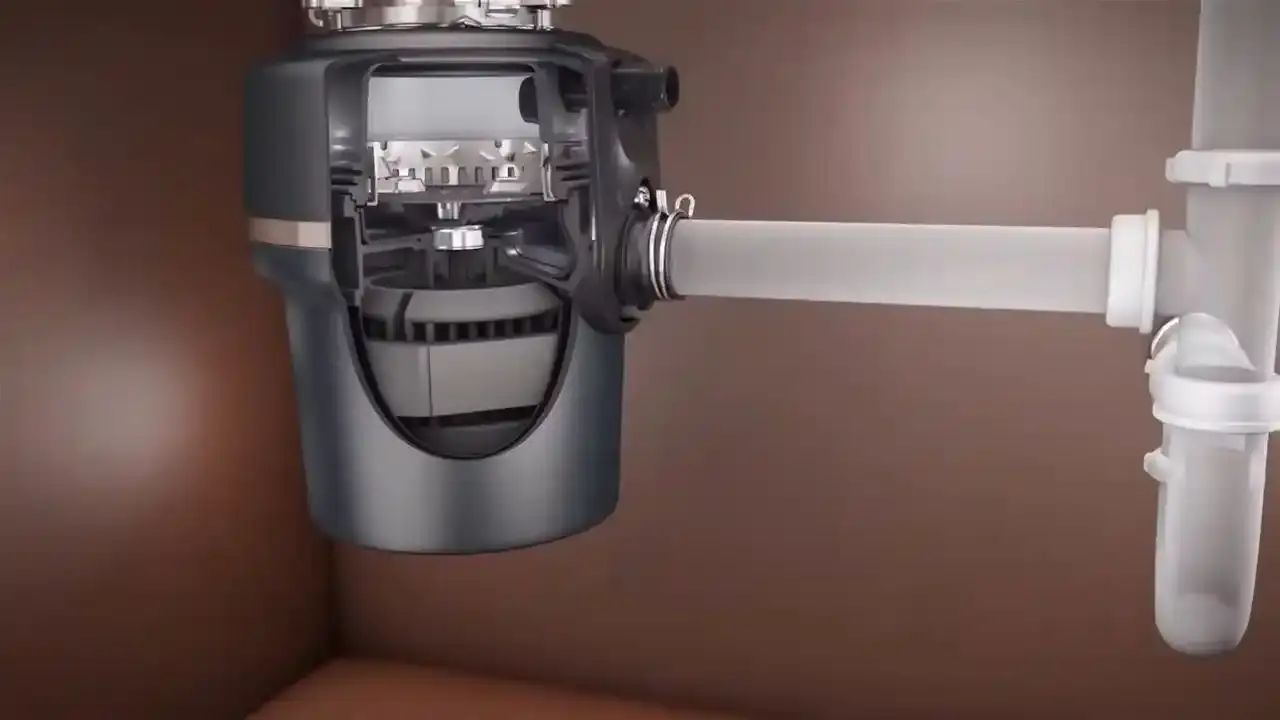
Start with safety
Turn off the switch and unplug the unit or turn off its breaker before you touch anything. Never put your hand into the chamber. Use a wooden spoon handle or tongs to remove an object you can see. Disposals do not forgive a mistake.
Symptoms and what they mean
Match what you hear and see.
| Symptom | Likely cause | What to try |
|---|---|---|
| Hums, will not spin | Jam on the grinding plate | Hex wrench in the bottom socket, then reset |
| Dead silent | Tripped reset or switch fault | Press the red reset button, check the breaker |
| Leaks from the bottom | Failed seal or cracked housing | Replace the unit |
| Leaks at the top | Loose mounting or old gasket | Tighten or reseal the flange |
| Drains slowly | Clog in the line past the disposal | Clear the drain |
| Smells | Food residue | Ice and citrus peel, then flush |
Freeing a jam
With the power off, insert a hex wrench into the socket at the bottom of the unit and turn it back and forth until it moves freely. Remove whatever caused the jam, then press the reset button and run cold water as you test it. If it jams again quickly, the grinding plate or motor may be failing.
Leaks: where the water comes from
Run the unit with the sink full and look at each connection. A leak at the sink flange means the mounting is loose. A leak at the dishwasher hose or the drain elbow is a gasket or clamp. A leak from the bottom of the body is the one that means replacement. Water under a sink can also come from the sink itself or the faucet, so dry the area and watch.
Repair or replace
A disposal lasts roughly ten years on average. If yours is newer and the problem is a jam or a loose connection, repair makes sense. If it leaks from the body, trips breakers or is far past its age, replacement is the better value. Our disposal repair page lists what we do on a visit.
Choosing a new unit
Larger motors grind more and run quieter. A continuous-feed unit suits most homes. Sound insulation, stainless grinding parts and an included power cord vary. Ask whether your sink flange and drain trap will work with the new unit, because mismatched parts cause leaks.
Habits that prevent most problems
Run cold water before, during and for fifteen seconds after use. Avoid grease, fibrous vegetables like celery, and large bones. Never put coffee grounds in by the cupful. Clean the unit with ice and citrus occasionally, and never use chemical drain cleaner in it.
If the sink is backing up
A disposal that runs fine while the sink drains slowly points to a clog beyond it. The drain cleaning page covers kitchen lines, which clog with grease.
Electrical connection and safety
A disposal is wired either with a plug into an outlet under the sink or hardwired into a junction box. Either way, the power should be off at the breaker before any work. A disposal that trips the breaker as soon as it starts has a shorted motor or a jam, and resetting the breaker repeatedly can overheat the wiring.
Dishwasher connection
A dishwasher drains through a hose into the disposal body. A new disposal has a knockout plug in that port, and it must be removed with a hammer and screwdriver before the hose is connected. Forgetting the plug is a common cause of a dishwasher that will not drain after a new disposal goes in.
Noise and vibration
A rattle can mean a spoon or a bottle cap is trapped. A deep rumble often means a worn bearing. A unit that vibrates against the cabinet may need a better mount or sound insulation. Run it empty for a few seconds, and if the sound is metal on metal, turn it off and call.
Costs to expect
Price varies with the unit, the labor and any plumbing changes. A swap on the same drain is the lowest cost. Needing a new trap, a longer drain arm or a new outlet adds to it. We quote a clear price before work starts, and we separate the unit from the labor so you can compare.