
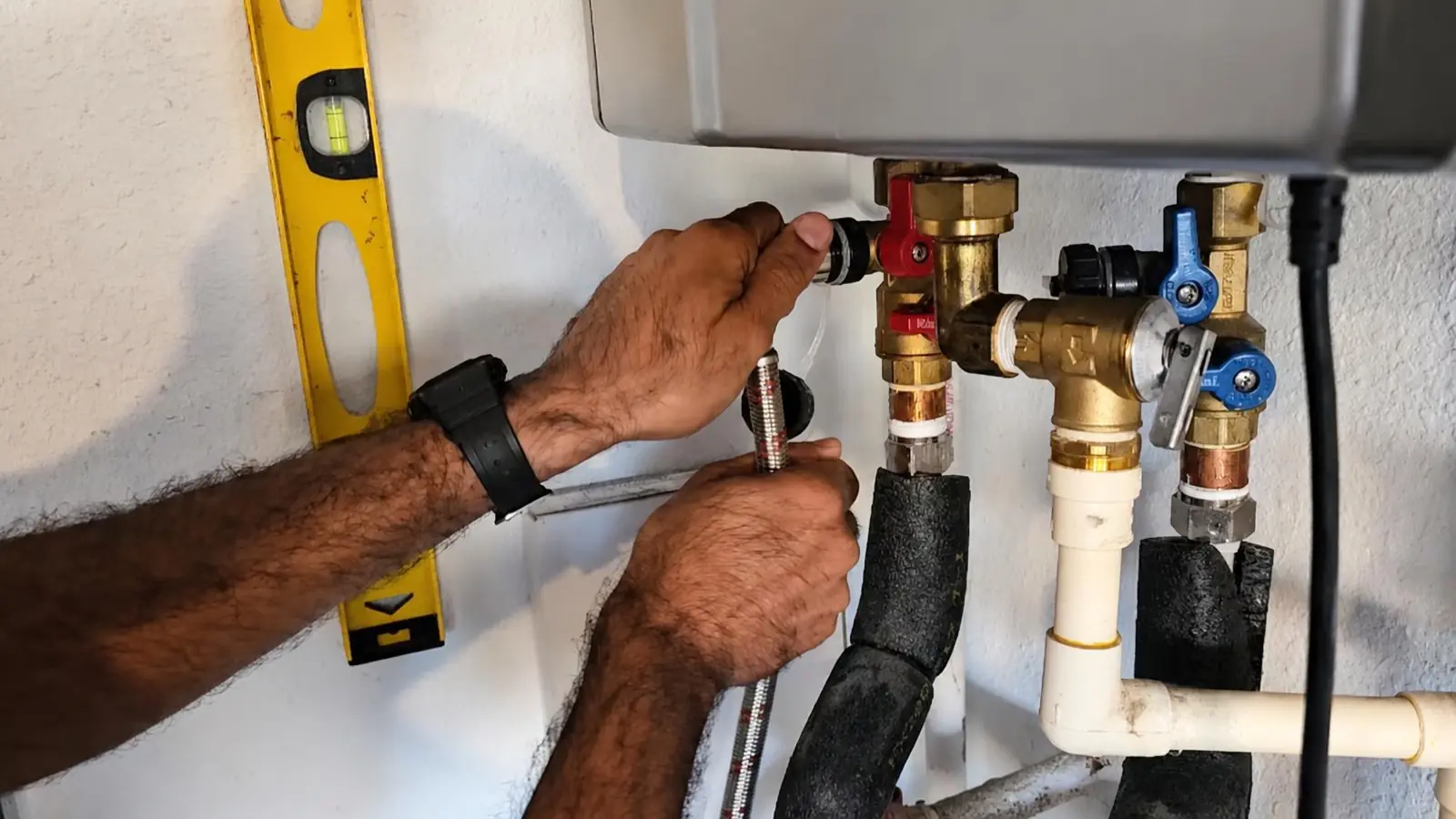
The four things a tankless unit needs
Check these before you pick a model.
| Need | Why it matters |
|---|---|
| Gas line size | A tankless burns far more gas per hour than a tank, so a small line may need upsizing |
| Venting | Direct-vent PVC or stainless to the outside, with allowed lengths and bends |
| Condensate drain | High-efficiency units produce acidic condensate that must drain safely |
| Electric outlet | The control board and fan need power |
Sizing by flow, not by tank gallons
Tankless units are sized by how many gallons per minute they can heat, and by the temperature rise. A shower uses roughly two gallons per minute, a kitchen faucet one or two, and a washing machine a few. Add what runs at the same time on a typical morning, and check the unit's rating at your cold incoming water temperature, which is lower in winter.
Venting and the condo problem
Venting is the item that kills tankless projects in multi-unit buildings. The vent must reach outside through an exterior wall or the roof. In a condo, that may mean approval from the association and a route that does not run through someone else's space. Ask first, because a no-go on venting ends the project.
Hard water and descaling
Minerals build up inside a tankless heat exchanger. A scheduled flush protects it, and most manufacturers require periodic maintenance to keep a warranty. Ask your water utility for its annual water quality report, or test your tap. See tankless water heater service for what a flush involves.
What it costs, and why it varies
The unit itself is only part of the price. Gas line upsizing, new vent pipe, a condensate drain, a new outlet and removal of the old tank each add. Two quotes can differ a lot if one leaves out the gas line work, so compare scopes, not just totals.
When to skip tankless
Keep a tank when the gas line is far too small, no vent route exists, or the household uses little hot water. For planned work in a tank home, see water heater installation.
Gas pressure and BTU rating
Every gas tankless has a maximum input, measured in BTUs per hour. The gas line and meter must deliver that much at the required pressure while other gas appliances run. A technician measures gas pressure with the unit firing, and compares it with the manufacturer's requirement. A line that tests low means upsizing before installation.
Condensate and neutralization
Condensing tankless heaters pull extra heat from exhaust and produce acidic condensate. The condensate line must drain to a floor drain or a pump, and many installations add a neutralizer cartridge. Where the drain is far from the unit, a small condensate pump is needed.
Wait time and recirculation
Tankless units heat on demand, but hot water still has to travel through the pipe to the faucet. A long run means a wait and wasted water. A recirculation line or a small buffer tank shortens the wait. Ask whether the model you consider supports it.
Maintenance schedule
Plan on an annual check and a scheduled flush, with the inlet filter cleaned. The manufacturer's manual gives the intervals. Skipping maintenance can void a warranty and shorten the life of the heat exchanger.
Warranty and registration
Register the unit and keep the paperwork. Warranty terms often require installation by a licensed plumber and proof of maintenance. Ask what is covered and for how long before you commit.
Maintenance that keeps the warranty
A tankless unit needs its heat exchanger flushed with a descaling solution on a schedule, often once a year where water is hard. Skipping it lets scale build up and the unit loses efficiency and can fault out. Ask the installer to install service valves on the water lines, because they make flushing a short job instead of a long one. Keep a record of each flush, since a warranty claim may ask for it.